


Nestled along the windswept shores of Namibia's Atlantic coast, the picturesque town of Swakopmund beckons travelers with its blend of natural beauty, rich history, and vibrant cultural tapestry. While its culinary scene boasts gems like Villa Margherita, Swakopmund offers a plethora of experiences beyond the dining table. From heart-pounding desert adventures to leisurely strolls through colonial streets, Swakopmund invites visitors to explore its diverse landscape and immerse themselves in the essence of...
Villa Margherita: No place like home
Posted on Wed September 2, 2026.
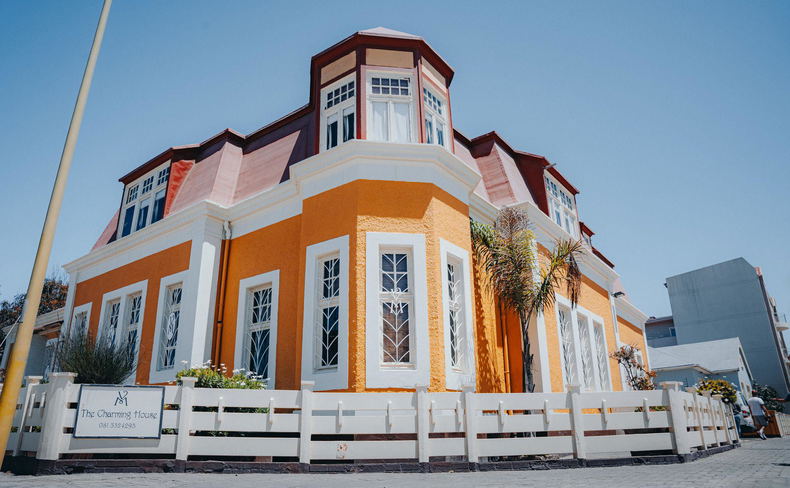
Villa Margherita is not simply Italian mother, Margherita, greets guests in the hotel’s a boutique hotel; it’s rather a story of intuition, resilience, and the belief that sometimes, when a place feels like home, you must trust that feeling.
words by Linda de Jager | photographs supplied
Upon my arrival at Villa Margherita Boutique Hotel and Restaurant in central Swakopmund, I find a charming bookmark on my pillow, reading: “May your luggage be light, your book be good, and your memories unforgettable.”
I have failed on the luggage front (mine was far from light), but at least a massage was within reach. The establishment has an in-house massage studio open to both guests and visitors. I booked a 90-minute session – something to look forward to after settling in.
My room is at Villa Tulipano next to the main manor, which is a family unit with two suites – the Tristano and the Isotta. The Italian names were chosen by Claudine Schamberger, the custodian and visionary behind the villa and its renovation, who grew up in the Italian-speaking part of Switzerland I am booked into the Isotta, but together the suites can accommodate up to six guests.
Beauty, Culture and Layered History
Claudine says her upbringing has shaped her appreciation of beauty, culture, and layered history, “quietly influencing the spirit of Villa Margherita today”. The walls of Villa Tulipano are adorned with well-curated historic photos of Namibia’s early days, collected and printed by Chris Johnson, an American-born photographer based at Omaruru.
The powerful imagery adds depth and narrative to the spaces, subtly connecting the interiors of the Villa to
Namibia’s landscapes and heritage. Speaking of which, many of the boutique hotel’s key staff members speak Khoekhoegowab, the language mainly spoken by Namibia’s Damara and Nama people. Queen Jacobs, my masseuse and a natural healer, says she was born at Otjiwarongo and comes from a family of healers. Both her
mother and grandfather practised what she calls “ǃguriǂui,” Queen explains.
“I understand what my clients need by listening to their bodies,” she says. I later received clarification about the word from Sylvanus Job, a lecturer in Khoekhoegowab at the University of Namibia. He says, “The word is ‘ǃguriǂui,’ which literally means ‘massage towards outside.’ It refers to massaging ‘pains, winds, and gases’ out of the human body.” But I digress -- what is the point of travelling if you cannot discover things along the way?
Still deeply under the spell of the sensuous, I make my way to the restaurant located in the old building, which is open to the public, and my experience just gets better.
High Tea and Fine Dining
“We initially cooked exclusively for our in-house guests, but everything changed in December 2024 when the talented Jako van Vuuren became our head chef,” Claudine says. Under his guidance, Villa Margherita opened its restaurant to the public, offering contemporary fine dining that emphasises slow cuisine and seasonality.
“Our menus, inspired by locally sourced ingredients, change every two months. For special occasions like
Christmas, Easter, and Valentine’s Day, chef Jako crafts exclusive five- to seven-course menus.”
Jako is definitely talented, and my travel companion promptly makes a Valentine’s Day dinner booking after our
dining experience. “Today, our restaurant is the perfect venue for intimate celebrations, weddings, and private events, featuring 22 seats indoors and 30 in the garden,” Claudine says.
She describes the restaurant’s high tea events for local and international guests as elegant and well organised, reflecting the villa’s spirit. In 2025, the establishment got its own vertical hydroponic garden, now supplying fresh greens to the kitchen daily, reinforcing Villa Margherita Boutique Hotel and Restaurant’s commitment to sustainability.
A Mother’s Love of Africa
A black-and-white photograph of Claudine’s Swiss-Italian mother, Margherita, greets guests in the hotel’s
historic entrance hall. Villa Margherita was named after her, with Margherita meaning “daisy” in Italian. “. . . the affectionate nickname my father gave her for her beauty and pure heart”. “My mother first came with me to Namibia in 2006, returning annually to soak in the land she’d long dreamed of. As a child in Germany, she studied South West Africa in school and imagined its distant landscapes, a dream she finally realised late in her life.
“We travelled together across Namibia and neighbouring countries, united by our love for Africa’s wildlife, vast landscapes, and people. She relished every adventure, once joking that crossing deserts as my co-pilot was her own Paris–Dakar Rally.
“She loved Africa and its people deeply, touching many lives with her sensitivity and respect,” Claudine shares.
In 2017 though, while visiting her daughter at Swakopmund, Margherita’s heart failed. Days later, she took
her final journey to Cape Town for treatment. “She passed away soon after, leaving behind a legacy of grace, courage, and her love for the Africa of her dreams,” Claudine shares.
The Doctor’s Mansion
Joyce mentions that the building where it all started, known as Dr Schwietering Haus, was the private residence of Swakopmund’s first doctor, Dr Schwietering. This historic private home offers three luxurious rooms
and three suites, each with mostly independent access -- ideal for groups or families.
Here, the restoration reveals its finest touches: spacious bathrooms, and old stairs spiral upward to a secluded, Romeo-and-Juliet-style room adorned with stunning sculptures. Claudine says she personally curated every aspect of the interior, “from the colour palettes to the eclectic mix of furniture and fittings blending antiques with contemporary pieces”.
It is the top floor of Dr Schwietering Haus that truly captures my heart. There, I open a window, Juliet-like,
gazing down at another colonial building standing diagonally across the street from Daniel Tjongarero Ave: the Deutsche Evangelisch-Lutherische Kirche. Like Villa Margherita, this is also a renowned Namibian architectural landmark. It was named a national monument in 1978 and is still a place of worship. Dr Schwietering is said
to have ridden his horses through dunes that once reached the building’s doorstep every evening. The doctor’s horse stables, now restored cottages, bear the names Lord Nelson and Lady Hamilton.
In my mind’s eye, I see the good doctor opening the stalls, his horses eager for the freedom of the beach. Faintly, a voice drifts through time from the church in Hochdeutsch, following the sound of a black horse’s hooves: In Christus liegen verborgen alle Schätze der Weisheit und der Erkenntnis. I smell the sea, can almost hear the gallop down the street, and glimpse the old doctor vanishing into the early morning mist on horseback.
Historical records do not show that Dr Schwietering Haus was built alongside the church, designed by Otto Ertl with FH Schmidt as building contractor.
The pastor’s house next door was built by Hermann Wille, and perhaps, as the records suggest, so was the
Schwietering house -- though it rose in 1913, a year after the church with its unforgettable stained glass first welcomed worshippers in 1912.
Claudine later assures me there is nothing romantic about restoring an old house.
Few want to hear about the burst pipes, collapsed ceilings, missing contractors or materials, or the handmade
tiles that crack just before installation -- not to mention the challenge of gardening in a coastal desert.
“Every obstacle has shaped the villa’s character,” she says. The journey has built resilience and meaning into its walls: Today, Villa Margherita stands as a testament to perseverance, blending history with the new, fusing the gifts of every culture from Damara to German (with a dash of Swiss-Italian) and different eras into something that somehow works -- something that speaks of renewal and healing. It’s like a charm, and as the sign on the gate states, this is “the charming guest house”.
Further Reading
Things to do in Swakopmund
Fri April 12, 2024
Read This Article
Exploring the Timeless Charms: Unraveling the History of Swakopmund
Mon March 25, 2024
Read This Article
Discover the captivating allure of Swakopmund, Namibia's coastal gem steeped in a rich tapestry of history and adventure. Founded during the German colonial era of the late 19th century, Swakopmund boasts a striking architectural heritage that echoes its past. Yet, it's not merely a relic of history but a vibrant hub where past and present intertwine seamlessly.
Share This Post